
ERC-7943 Author Says Institutions Can’t Play Defi’s ‘Pirate Game’


For years, crypto has thrived on speculative capital flows and the explosive popularity of decentralized finance (DeFi) tokens and applications.
That still holds true for rising sectors such as perpetual decentralized exchanges and prediction markets. But as Wall Street pushes deeper into tokenized real-world assets (RWAs), not all of the industry’s existing systems cater to the kinds of financial products institutions want to bring onchain.
An author of the newly finalized ERC-7943 (uRWA) token standard said that the fragmented infrastructure powering much of DeFi wasn’t designed for regulated financial assets, which often require identity frameworks and interoperability standards.
“If you want to bring regulated assets onchain, you can’t really escape regulations,” Dario Lo Buglio, co-founder and head of blockchain at tokenization platform Brickken, told Cointelegraph.
“You can still play your pirate game on DeFi without regulated assets.”
DeFi veterans have been wary of freezing functions in tokens, but the same controls appeal to institutions. Source: ethereum.org
Existing standards don’t cover every RWA use case
Another token standard, the ERC-3643 — also known as the T-REX or Token for Regulated Exchanges — is one of the dominant frameworks used for tokenized securities on Ethereum.
The standard already includes many of the compliance-oriented features institutions require, like identity-based permissions and mechanisms that allow issuers to intervene under specific circumstances.
The framework was designed primarily around securities and does not necessarily translate across the broader range of tokenized assets now entering blockchain markets, Lo Buglio said. Thus, interoperability is increasingly difficult as more institutions experiment with bringing traditional financial products onchain.
“As tokenization becomes easier, the harder problem is making those assets work across different compliance systems, custodians, exchanges, wallets and institutional platforms,” Markus Levin, co-founder of XYO, told Cointelegraph.
Levin said standards such as uRWA could help standardize how tokenized assets carry information tied to identity, permissions, compliance requirements and transfer rules across Ethereum-based systems.
“Done well, that makes regulated assets far easier to move, verify and integrate without every institution building its own isolated infrastructure,” he said.
Tokenized RWAs grew from roughly $6.4 billion at the start of 2025 to about $34 billion as of Thursday, according to RWA.xyz data. Standard Chartered estimates this value to pop to $2 trillion by the end of 2028, while the Boston Consulting Group projects $18.9 trillion by 2033.
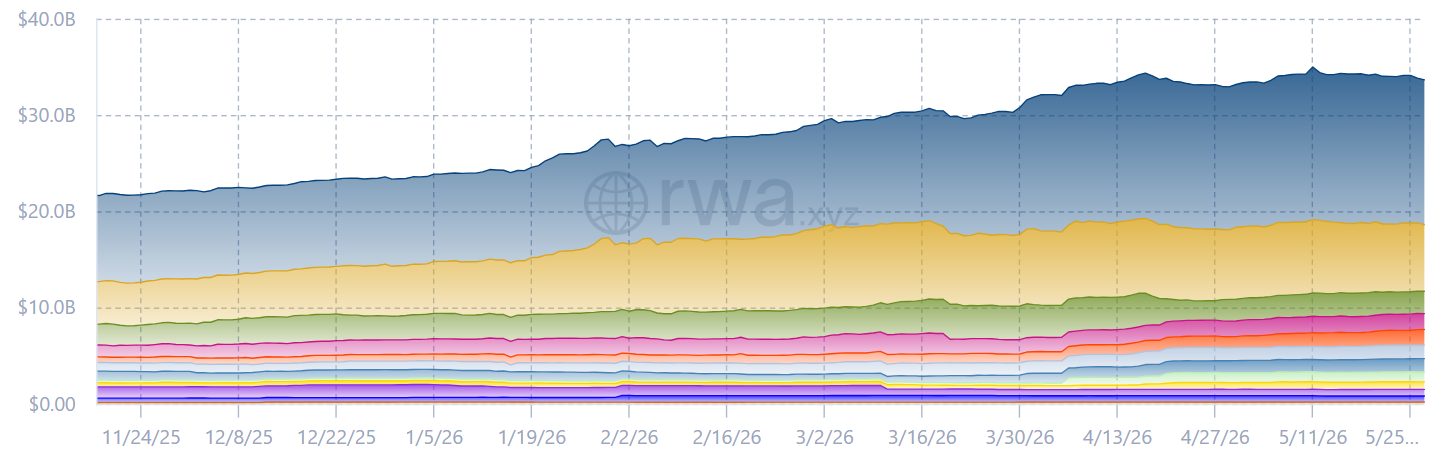
In measurements that classify stablecoins as RWAs, the total market capitalization is approaching $340 billion. Source: RWA.xyz
Related: Wall Street’s tokenization boom has a liquidity problem: Axis CEO
Levin added that institutions have largely prioritized assets with predictable cash flows, real yield and established legal structures.
“The market is tokenizing what benefits most from faster settlement, programmable collateral and lower operational friction,” he said.
Privacy as the next institutional requirement
Privacy remains another major obstacle for institutions experimenting with onchain finance, particularly for firms unwilling to expose portfolio activity or transaction flows on public blockchains.
“We don’t want BlackRock listing their entire portfolio onchain transparently to everyone, but they still want to transact onchain,” he said.
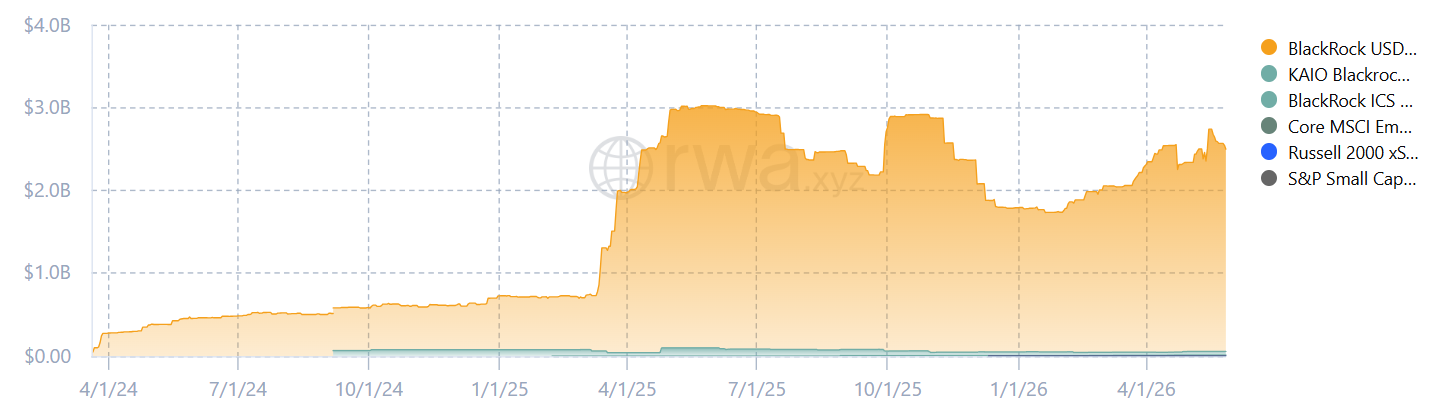
BlackRock’s institutional liquidity fund is worth about $2.5 billion. Source: RWA.xyz
Related: DeFi hacks shake institutional confidence as risks outpace yields
Lo Buglio argued that many existing tokenization frameworks were originally designed around public Ethereum-based systems and do not always translate cleanly to privacy-oriented chains, where transaction models and data structures often differ from traditional EVM environments.
Canton Network, which was launched with backing from firms including Goldman Sachs, Microsoft and Cboe Global Markets, was designed around privacy-preserving financial coordination between institutions.
Unlike public blockchains where transaction activity is broadly visible across the network, Canton allows data to remain visible only to relevant participants while still synchronizing settlement between institutions.
Its architecture has irked some developers who argue the network lacks key characteristics associated with public blockchains, including a globally shared state.
The debate reflects a growing divide between crypto-native DeFi infrastructure and the types of blockchain systems many large financial firms appear more willing to adopt for regulated assets.
AI agents may push RWAs beyond TradFi
Much of the current conversation around tokenized RWA has centered on banks and institutional systems. But some builders believe the infrastructure now being developed for RWAs could eventually branch out to machine-driven financial systems.
“As AI agents begin to move capital autonomously, they will need assets that exist on-chain in a form they can read and act on,” Taran Dhillon, head of digital assets at tokenization company Kula, told Cointelegraph.
According to Dhillon, many productive RWAs still remain largely disconnected from automated financial systems because they lack standardized digital infrastructure.
“The standards being built today need to work across jurisdictions and asset classes, not just within the existing corridors of established financial markets,” he said.
Lo Buglio similarly argued that ERC-7943 was designed less as a single dominant implementation and more as a framework allowing tokenized assets to move across increasingly interconnected blockchain environments.
ERC-7943 moved to the “final” stage in its Ethereum Improvement Proposal process on Wednesday, meaning developers can deploy contracts based on the standard without expecting further specification changes. The next phase will likely focus on adoption across tokenized asset platforms.
The emergence of another tokenization standard may not immediately solve the lack of standardization issue it aims to address.
Lo Buglio acknowledged that ERC-7943 was intentionally designed as a more flexible and less “opinionated” framework than some earlier standards.
Large financial institutions and blockchain developers continue to experiment with proprietary infrastructure and custom compliance systems.
Magazine: Big Questions: Do we really only need 2–5 cryptocurrencies?



