
SpaceX Plunges to New Low as Musk’s Fortune Bleeds $35 Billion in One Day


Key Takeaways
SpaceX fell near $111 on July 23, more than 50% below its June peak.Elon Musk lost $35.2 billion as SpaceX and Tesla declined Thursday.SpaceX may unlock 911.5 million shares after its Aug. 4 earnings report.
SpaceX market data recorded at 11:30 a.m. EDT via Tradingview on July 23 showed SpaceX trading near $111, down from Wednesday’s $115.26 close and roughly 18% below its $135 initial public offering price. Shares traded between approximately $110.99 and $116.80 during the morning session, placing the company near the bottom of its brief public trading range.
The decline marked a dramatic reversal from SpaceX’s June 12 debut. The aerospace and satellite company raised $85.7 billion after underwriters exercised their overallotment option, making the offering the largest IPO on record. Shares opened at $150 and finished their first session at $160.95, 19.2% above the offer price.
A $1 Trillion Reversal
Investor demand pushed SpaceX as high as $225.64 on June 16, briefly valuing the company above $2.6 trillion. Thursday’s price near $111 represented a decline of about 51% from that intraday peak, reducing its market capitalization to roughly $1.5 trillion.
The sell-off has accelerated since July 15, when SpaceX closed at $135.27. It ended the next session at $131.11, fell to $123.99 on July 17, and closed at $119.85 on July 20. A brief rebound to $123.54 on Tuesday was followed by a 6.7% decline on Wednesday and further losses on Thursday morning.
Short sellers have been among the largest beneficiaries. Ortex Technologies estimated that bearish positions generated about $15.5 billion in paper profits following the decline. Roughly 360 million shares, representing about 56% of the freely tradable SpaceX stock, were on loan to short sellers, according to a report from Reuters.
SpaceX’s limited public float contributed to both sides of the move. Scarce shares intensified demand immediately after the IPO, but the same structure increased volatility once investors began taking profits and questioning a valuation that approached 40 times estimated 2026 sales.
Starship and Share Supply Add Pressure
Operational uncertainty also entered the market after SpaceX aborted Starship’s 13th test flight on July 16. Four of the Super Heavy booster’s 33 Raptor engines failed to meet ignition requirements, prompting the flight computer to cancel the launch less than a second before liftoff. Musk said two engines would be replaced.
SpaceX rescheduled the flight for Thursday evening, with a 90-minute launch window beginning at 6:45 p.m. EDT. The mission is expected to test Starship’s propulsion and reusability systems while deploying 20 next-generation Starlink satellites. Its performance could shape investor confidence in a program central to SpaceX’s launch, satellite, and lunar ambitions.
A much larger financial test arrives in August. SpaceX is scheduled to publish its first quarterly report as a public company after the market closes Aug. 4. As many as 911.5 million restricted shares could become eligible for sale Aug. 6, the second full trading day following the report. At Thursday’s price, that potential supply would be worth more than $100 billion.
Investors will examine Starlink revenue, launch activity, operating losses, capital spending, and cash requirements. The company reported a $4.9 billion net loss in 2025 and a $4.28 billion loss during the first quarter of 2026, according to figures cited in reports surrounding the earnings announcement. SpaceX is also the eighth-largest public company in terms of BTC on its balance sheet, with an aggregate of 18,712 BTC.
Musk’s Fortune Takes a Dual Hit
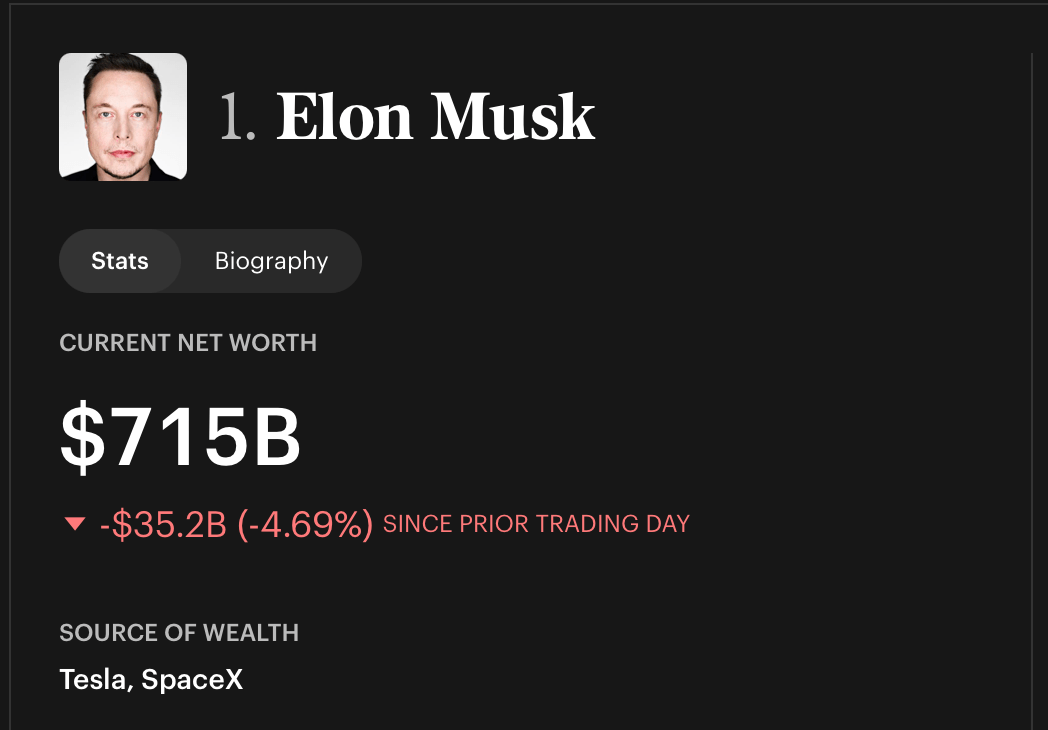
Musk’s net worth stood at approximately $715 billion at 11:30 a.m. EDT, according to Forbes’ real-time estimate provided with the market data. That represented a one-day decline of $35.2 billion, or 4.69%, as SpaceX and Tesla fell simultaneously.
Tesla traded near $322 Thursday morning, down almost 14% from its previous close and at the session low when the market reading was captured. Because Musk’s wealth remains concentrated in SpaceX and Tesla, large moves in either company can add or remove tens of billions of dollars from his estimated fortune.
The declines do not change Musk’s control of SpaceX or require him to sell shares. They do, however, illustrate the volatility of fortunes built largely on publicly traded equity. Musk briefly exceeded $1 trillion in estimated wealth after SpaceX’s debut, but the stock’s retreat has removed much of that post-IPO increase.
SpaceX remains one of the world’s most valuable companies, with dominant positions in commercial launches and satellite broadband. Its immediate market direction will depend on whether Starship can return to flight, whether August earnings support its valuation and how investors absorb a potentially substantial expansion of the public float.
By 11:45 a.m. EDT on Thursday, SPCX was exchanging hands for just over $112 per share.



